Monday, 23 October 2023

FIND GOOD FINANCIAL ADVICE

How do I find a good financial adviser? It's a question I am often asked. And there is no easy answer. Especially if you do not have a lot of money.  


My first question is do you need financial advice? Unless you have a big lump-sum (tens of thousands of pounds or more) or a lot of surplus income to invest (hundreds of pounds a month) you probably don't need financial advice and probably will not want to pay the fees good advisers charge. See free financial advice below for other services that can help you.  

But if you do want regulated financial advice then here is my guide. Many people first want or need advice when they think about exercising their new pension freedoms. Some with a fund worth than £30,000 or more which comes with a guarantee have to take regulated financial advice before they can transfer their money out either to another pension or, ultimately, to cash.

I have three filters to sort the best advisers from the others. 

Filter One - Independent
Only ever use an Independent Financial Adviser. This term is now regulated and policed under EU rules called MIFID II which began on 3 January 2018. Now that the transition period is over and the UK has left the ambit of the EU these rules have become part of UK law and the Financial Conduct Authority polices them.

Under these rules there are two main sorts of financial advisers.

The sort you want is called 'independent'. That can mean one of two things.

1. They give advice on all financial matters and looks across the whole of the market and give that advice on any financial topic where they might recommend a product.

2. They give advice on a specific type of product - such as annuities or pensions - and not on other types of product. But they must still look across the whole of the market relating to that product. This may be called 'focused independent' or may just be called 'independent'.

Any adviser who is not independent does not look at the whole of the market and may be tied to one or more firms and can only recommend products from those firms. In the UK these advisers are called 'restricted' though hardly any of them used that term. Never ever use an adviser who is restricted by products. If you ask 'do you offer independent financial advice' and the answer is anything but a clear 'yes' then reject them. Many work for a bank or insurance company and of course only recommend you buy their products. That is just sales masquerading as advice.

A lot of advisers will be rejected by Filter One. The only way through it is to become independent.

Filter Two - Planners
Only ever use an IFA who is a chartered or certified financial planner. The very best qualified financial advisers are chartered (or certified) financial planners. This brings you down to the best qualified 6000 or so of the 33,000 regulated financial advisers. They are beyond what is called QCF Level 6. So they have put a lot of effort into being the good guys and the chances of a bad guy (or gal) remaining in there is small. Some firms are chartered which means that at least some of their advisers are chartered themselves and the rest are probably working towards it.

Lots of good advisers will be rejected by Filter Two. Sorry. Get the qualifications.

Filter Three - Payment
My general position is only use a financial planner who you can pay in pounds. Do not choose one who wants to charge you a percentage of your money. You earned, made, or inherited it. Charging a percentage is like taxing your wealth. Even HMRC is not entitled to do that. 

Percentage fees are a hangover from the days of commission when advisers lived on a percentage of your money they were paid year after year. If you cannot afford the fee in pounds then you probably do not need or cannot afford financial advice. 

However, in some very limited circumstances a small percentage charge - say 0.5% or so - can be better value than paying in pounds. But always make sure that:
  • you know each year how much has been taken from you so you can see if it is value for money.
  • you review the service you get every year and if it is poor, find another adviser.
Ideally you should also pay upfront from your non-invested resources rather than out of your invested money. One drawback of that approach is that a fee taken out of your pension fund comes from money which has already had income tax relief. So ultimately that fee costs you less than if you paid it out of your taxed income. It is all part of the massive taxpayer subsidies for the financial services industry (relief from VAT for finance and insurance costs £11 billion a year). That was originally an EU law but is very unlikely to change once we have finally left the EU in 2021. If you must, then pay in tax-subsidised pounds from your pension fund. But ideally - and with all other investments - pay in pounds out of your non-invested resources. That way you see the money you are paying and can ask yourself – is it worth it? And unless it is good value and you know what it is and what you get for it never pay a wealth tax to the adviser from your fund. 

Contingent fees
One iniquitous method of charging grew up around pension transfers. If you have a good company pension that promises you a pension related to your salary - called Final Salary or sometimes Career Average schemes (they are branded Defined Benefit or DB schemes by the industry) you may be tempted to transfer it to a pension pot scheme - a money purchase or Defined Contribution (DC) scheme.

Transferring out of a DB scheme into a DC scheme can seem very tempting because you will get a massive amount of money to move away from the guaranteed DB pension. And then if you choose to do so you can cash some or all of that pension in. It is almost always a bad idea. In the past some financial advisers who would deal with this for you (you have to get advice if your pension is worth a transfer value of £30,000 or more) charged on a 'contingent' basis. That meant you only paid them if you took their advice and transfered your fund. Such fees created a conflict of interest between you and the adviser who was only paid if you transfered. The FCA finally saw sense and banned contingent fees from 1 October 2020. 

The difficulties of advising people about pension transfers and the cost of insurance mean that relatively few advisers will handle this business. Esepcially if you do not have a very valuable pension. 

Next steps
These three filters will take you a long way towards finding good, safe, but often expensive, financial advice. There may be adequate or even good, safe, and perhaps cheaper advisers which have been filtered out. They can get themselves through my three filters by becoming independent, getting financial planning qualifications, and changing the way they charge.

I must also add that there are a small number of well qualified independent financial advisers who have given dreadful advice (especially about pension transfers), have gone out of business, or have even turned out to be crooks. So these three filters are not a guarantee but they are a good start.

Website research
You can apply your three filters using online directories of financial advisers.

1. Adviser Book is the newest directory. Unlike the others no-one pays to be included. It has the complete list of more than 12,000 FCA regulated adviser firms on it but it does not yet list individual advisers separately. It clearly states who is verified as independent thouhg most of them are still unverified. You can filter by qualifications and specialisms. You can also filter by independent and how fees are charged.

2. Unbiased was the first real attempt at a comprehensive database. It says it lists more than 18,000 financial advisers who are mainly independent but some are restricted. Advisers get a basic listing free but they must pay a subscription to be directly contactable through the website. You will see a list of the 'top 20' near your postcode which unbiased says is based on how near they are to you.

You can use the site to apply my filters. You can also make other choices such as specialisms or qualifications. You can even pick a male or a female adviser.

3. Vouched For uses its algorithms to provide a list of advisers for you. They are ordered to take account of how local they are to you, reviews by customers, and ratings. Advisers cannot pay for a better position in the list. The site checks qualifications by asking the senior manager who is responbile for them and checks that periodically. It demands images of certificate for qualifcations.

You can filter by speciality, by independent or not, and by qualification. And each entry shows clearly if the adviser is independent or restricted - always reject the latter of course. It will also show the minimum amount of money you need for them to take you on as a client. 

Vouched For lists about 8000 financial advisers who choose to pay the fees to be included and of those 3000 are full vouched for - you can only click through to the adviser website for those. 

Other listings are available but they are much less useful. The Personal Finance Society lists all the advisers who have its qualifications and are Chartered Financial Planners, or are on the way to becoming Chartered, or work for a firm which is Chartered. That is a useful check. But it does not indicate if they are independent.

Next steps
After using these sites and checking for independence, qualifications, and how they charge, you should then pick two or three you fancy.

I would only use an IFA who has a website where you can find out more. Ignore the slick sales patter which usually reads as though it is generated by a PR machine. You'll find similar meaningless platitudes on most of them.

Most adviser websites do not tell you how much they charge - I would tend to pick only those that do. Certainly make that your first question when you meet them. If the answer is anythnig but clea that is a warning flag. Also ask what it will be in pounds (if they haven't told you) and then ask what you get for that fee.

Most advisers will give you one free session. Go prepared with details and information about yourself. Try two or three and see which you prefer. Do not be embarrassed to say 'no' to them.

If you pick an adviser but later regret it you can leave by just writing them a letter telling them that they are no longer your adviser. Ask them to return any documents and destroy all your data. If you feel you have been badly advised or locked into investments you did not want, then complain and pursue the complaint to the Financial Ombudsman Service.

Free financial advice 
If you want financial advice outside the regulated professionals, then try the free, Government approved Money Helper site. That is the new name for what used to be called the Money Advice Serivce. Its website is very good on a whole range of money issues, some of which many financial advisers will know little or nothing about. Or you may want to consider joining Which? and subscribing to its Which? Money Helpline. That will cost you £10.75 a month.

If you have pension questions then you can still contact the Pensions Advisory Service which has a helpful helpline on 0300 123 1047. The service is now part of Money Helper. It is free and approved by the Government.

Specific advice about the pension freedoms which began in April 2015 can be found at Pension Wise. If you are over 50 you can call 0300 330 1001 to book an appointment for one-to-one telephone advice, or a face-to-face interview at a nearby Citizen's Advice office. Again, Pension Wise is now part of  Money Helper.

Footnote
Only the term 'independent financial advice' is regulated. Anyone can call themselves a 'financial adviser', an 'investment manager', or a 'property specialist'. And they do. All those terms are meaningless. Some call themselves International Financial Advisers which they abbreviate to IFA trying to give the impression that they are Independent Financial Advisers. They are not and are probably not even regulated. All these people are allowed to operate unregulated as long as they only sell unregulated investments in things like whisky, property, or art. Your money is completely at risk. 

If an adviser does not use the word 'independent' or does not say simply say 'yes' when you ask if they are independent, then they are not. Avoid them. Always ask for a Financial Conduct Authority number and check it out on the Financial Services Register. Not all individual regulated advisers are on it. But all regulated firms are so ask the adviser about their firm. Then use the contact details on the FSA Register to check with that firm is the person who claims to work for them does so. 

Sadly - and madly - the register does not say if the adviser is independent or restricted. Sadly - and madly - again, changes to the Register mean that it is not as comprehensive as it was. But never trust someone who is not on it. And be cautious even about those who are.

If you are ever cold called or receive a text or email from an adviser you have not found and researched just say 'no'. No-one ever lost money by doing that. Many have lost money by not doing that.

Paul Lewis
23 October 2023
Vs. 2.7
25134 
21332
18798
17906
17725

Tuesday, 3 October 2023

DON'T TAKE AWAY WINTER FUEL PAYMENT

UPDATED 3 OCTOBER 2023

Another autumn, another round of people saying means-test the winter fuel payment. Somne even saying do that and use the money saved to save the triple lock.

Let me declare an interest. I am old enough to get the £200 tax-free Winter Fuel Payment (the extra £300 is a cost of living payment last year and this and not technically part of the WFP). And I might add I do not in the slightest need that money. If it disappeared tomorrow it would not leave me freezing in the winter and wondering whether to choose turning up the heating or buying a few groceries. 

So I get it; I do not need it; and the amount is small enough in my personal financial affairs that whether I get it or not is neither here nor there. 

That leaves me uniquely able to say unequivocally that it would be complicated, counterproductive, and wrong to stop Winter Fuel Payment for those over state pension age of 66. Here’s why.

First, complicated. Who would you take it away from? Everyone who admitted they didn’t need it? Everyone called Paul? Everyone who paid higher rate tax? That would be possible but it would create a cliff edge at an income of £50,270 – earn an extra £1 or your pension rises £1 a year and you would lose £200. And it would not save much. The Government estimated some years ago that ending it for households with an income above £35,000 would save just £270 million out of the total cost of more than £2 billion. The administrative cost could be £25 million a year or more.

You would save more by following what one tweeter suggested to me. Go down the income scale and only give these benefits to those poor enough to pay no income tax. Then the cliff edge would move down to £12,570. That would save more but would certainly take it away from many who did need winter fuel payment to keep warm in winter living on less than £241 a week.

Another problem is that these are individual entitlements so the non-taxpaying spouse or civil partner of a higher rate taxpayer would continue to get it. 

The same problem would be found if the payment was taxed as income. Where two pensioners share a household the £200 is split in two - £100 each. So each partner would have to be taxed separately on it. And where one partner earned, say, £1,000,000 a year and paid 45% tax on the payment, their partner may have no taxable income and pay nothing. So a household where many think the payment is not needed would still keep £155 of it. 

There would also be problems where the payment just tipped someone over from being a non-taxpayer to paying tax. How would the right amount be collected if, for example, winter fuel payment pushed an individual £50 above their tax threshold and they owed £10 tax? Solving those problems would be expensive and a back of the envelope calculation suggests the tax take might be less than £200 million a year. 

The next step might be link it to pension credit. But the level of pension credit is less for younger pensioners than it is for older ones. So that would be another divide. And of course an estimated 850,000 pensioners who could get pension credit do not claim it and would not get the Winter Fuel Payment either. Though as they are already living below the pensioner poverty line they certinly need it.

Now, I know your next argument. It is one I have made myself. Surely, you are thinking, surely all that Oxbridge brain power in the civil service can come up with SOME scheme to rid me of these turbulent pensioners? Well, they might. They did come up with a scheme to tax child benefit at up to 100% where a parent has an income over £50,000. That sort of works except a lot of those who should pay the tax did not know about it and are now being pursued for arrears. The others have the bother of filling out a self-assessment form or not claiming child benefit at all which could cause them problems later in life.

So that is the ‘complicated’ bit.

Now ‘counterproductive’. The thing about these universal benefits – ones that you get on grounds of age or condition – is that they go to everyone in those categories. Those who need them do not have to declare their poverty to get them. If they do have to take that step then many simply do not claim. A total of £19bn is unclaimed in varous means-tested benefits by people of all ages (Policy In Practice 2023). As I said an estimated 850,000 pensioners do not claim £1.75 billion in pension credit. Add in housing benefit and council tax support and the figure is a lot higher. 

Paying everyone Winter Fuel Payment is the price we pay as a society so that my neighbour Marjorie, too proud to claim means-tested benefits though she needed them, at least got her winter fuel payment in her last years. If you means-test winter fuel payment then poverty among pensioners would grow as many who needed it failed to claim what they could get. 

And finally ‘wrong’. In a way this is an extension of counterproductive. Some countries call the government departments that run social security or health the Ministry of Solidarity. Because state benefits represent solidarity. Between the sick and the well. Between the jobless and those in work. And, of course, between young and old. There are times and circumstances in life when the state should step in and transfer money from one group to another. Just as the childless pay for schools. The law abiding pay for the police force and the courts. And those without solar panels on their roof pay for those who get cheaper power from them. 

In summary, taking winter fuel payment away from richer older people or from older people deemed not to be poor would save relatively little, cost a lot in administration, increase poverty among the old, and undermine solidarity between the generations. 

This is a revised version of a blog first published in 2012 and 2015 when there was also a debate about whether to means-test free bus passes.

3 October 2023
version 2.0

Monday, 2 May 2022

DELAYS TO FUEL REBATES

Many local councils in England have failed to pay the £150 council tax discount to help with fuel bills by the original deadline of the end of April. The money is due to go to households in Council Tax bands A, B, C, and D.

The Chancellor Rishi Sunak told Parliament six times on 3 February that £150 would be paid 'in April'. He announced it by saying 

We are going to give people a £150 council tax rebate to help with the cost of energy in April, and this discount will not need to be repaid (Hansard col.472).

Answering questions from MPs he repeated five more times that the money would be paid 'in April', explaining to one MP  

By using the council tax system, we can get money to people faster - £150 in April (Hansard col.479).

Later at a Downing Street briefing and in an interview on BBC Newscast he repeated that it would be given 'in April' . The Treasury confirmed that date in a tweet 

In April, 80% of UK households will get a £150 council tax rebate to help manage rising global energy costs.

The Treasury used exactly the same wording on its Facebook page of 3 February and linked to a video of the Chancellor saying to the camera 

Secondly, in April, we're going to give a £150 council tax rebate to households in bands A to D to help with the immediate costs of energy.

A Factsheet issued by the Treasury at the time (a Treasury press officer referred to it in an email to me on 3 February as 'our factsheet') also confirmed the money would be paid 'in April'. 


A Council Tax Information Letter dated 14 February 2022 from the Department for Levelling Up, Housing & Communities (DLUHC) to local authorities in England says

On 3 February 2022, the Department issued a Council Tax Information Letter (CTIL) summarising the Government’s announcement that an Energy Bills Rebate will be provided to households in England in April 2022 to help protect them from rising energy costs.

Deadline changed
But at some stage the Treasury Factsheet was amended to the one now available online with a url indicating it is 'v.2' and the deadline has been changed to 'from April'.


Despite the evidence of Parliament, Twitter, Facebook, and the Factsheet that the original deadline was to pay the money 'in April' the Treasury claimed in a statement to journalists on 30 April 2022 that 

We’ve always been clear...that the £150 council tax rebate to help with the cost of living would be paid “from” April.

It referred to its press release of 3 February which did use the phrase 'from April'. But in Notes to Editors (labelled 'Further Information' in the version now online) it added 

We expect the vast majority of people who pay by Direct Debit to receive this money in April...for households in Bands A-D who do not pay by Direct Debit, their councils will be ready to process their claims in April.

Later guidance from the DLUHC also uses the phrase 'from April'. 

All Council Tax Rebate grants should be paid as soon as possible from April 

Original deadline missed
It is the original deadline set by the Chancellor and the Treasury of 'in April' which local councils up and down England have not met. Some did pay in April, others have said it will be May or even June before households on Direct Debit are paid and it could be as late as 30 September before those who pay in other ways get the £150. The end of September is the final deadline set by the Government for the payments to be made and after that it has made clear that any money not spent by councils on the rebate by 30 November 2022 would be taken back.

What to do
If you live in a band A-D home in England and are still waiting for your council tax Energy Bills Rebate the councils do not want you to call them. Check your council's website, though many of those I have seen have only very sparse information. 
  • If you pay by Direct Debit the rebate should be paid automatically. If it has not been credited to your bank account by the end of June you should contact the council and ask when you will be paid. Remind the council that the Chancellor and the Treasury initially promised the payment 'in April'.
  • People who do not pay by Direct Debit will probably have to wait longer. This group will include pensioners who get their council tax reduced to zero because of their low income. If the council has not contacted you by the end of June to ask for bank details then you should call the council and ask why. Remind the council that the Treasury said councils would be ready to process these claims 'in April' and that 'almost all households should see the full benefit by May'.
If you live in a band E, F, G, or H home but you are in hardship and need help with your energy bills you will have to apply to the council for money from the Discretionary Fund which the Government has provided to all councils in England.

Rest of the UK
In Scotland and Wales the payment is due to everyone in a band A-D home and is extended in both countries to people in higher bands E-H who get council tax reduction due to their low income. Both countries also have some extra funding to help those who fall outside the scope of the payment but are still in hardship. 

In Scotland councils can make the payment by reducing the council tax bill by £150 and many have done that. 

In Northern Ireland there is no council tax and no decision has yet been taken about how the payment will be made.

Version 1.10

3 May 2022


Tuesday, 26 April 2022


DOWN  AND  OUT  IN  MOSCOW 

 A  VIEW  FROM  RUSSIA 

 Paul  Lewis

Originally published Saga Magazine, September 1993, pp. 18-22.

Nikolay Andreevitch Yasinsky’s apartment is set back from Parkovaya Street 15th, so called because it is the fifteenth of sixteen parallel streets all called Ulitsa Parkovaya or Park Street which hatch the space between Moscow’s outer ring motorway and a long wide road called Okrusnoy Avenue. To the north lie the remains of the natural woodland on which this estate was built and the blocks of flats on Parkovaya Street 15th seem to have been placed among the fully grown trees without disturbing any that were more than six feet from their walls. 

War veteran Nikolay Andreevitch. He lost his leg during the battle to relieve the siege of Leningrad, but today he cannot afford to buy the vegetables he needs. 

Trees are the redeeming feature of Moscow’s dilapidated blocks of dreary flats which officially house nine million and actually accommodate thirteen million. They need redemption. At each address there are several buildings, set back from the road. Nikolay’s is a good 200 yards from the pavement along unmade roads relieved by scrap cars, earth playgrounds, and large rubbish containers. Four doors lead into his building. Through the first and up six short flights of stairs is apartment 85, building 5, number 42, Parkovaya Street 15 — home to Ukrainian Nikolay, aged 72.

He lost his left leg fighting to relieve the siege of Leningrad. “Where Pushkin was wounded, Black River” — he is proud to have been wounded at such an illustrious place. There is no lift in the building and the red and yellow tiles on the concrete landings and stairs are broken and uneven. On every other half-landing there is a rubbish chute. His front door is well locked and leads to a small hallway which gives on to a tiny kitchen, through which there is a balcony with a few plants. A second door leads to the bedsitting room where his small box bed is part of his daytime furniture. A table covered with an old carpet and a cheap settee fill the rest of the room. The finest objects are large, framed photographs of him and his wife taken before the war.

He has three rooms, though all are less than 12 feet square. One was his and his wife’s, one was their daughter and son-in-law’s, the other was for his grandson, his wife and their two-year-old daughter. Seven people crowded into three rooms, a typically crowded Moscow family flat. But last year his wife died of cancer and his daughter died of diabetes. A few months later his grandson, a soldier, was killed in a shooting accident and his widow and their baby have moved back to live with her parents. Now Nikolay Andreevitch lives alone with his son-in-law Viktor Mikhailovitch. The three-roomed apartment is too big for just the two of them. He weeps at the memory of the loved ones he has lost.

Nikolay’s pension is enough, he says. He gets 24,000 roubles a month — his flat costs him just 85 roubles a month. Over the last year all flats in Moscow have been privatised by the simplest possible means — handed over to the tenants. The 85 roubles covers heating, water, and rubbish collection. In addition, he pays 20 roubles for electricity and 106 roubles for the phone. Local calls are free. With the basics taken care of, Nikolay still has almost all the 24,000 roubles a month left for living.

It is impossible to say simply what a rouble is worth. If you go into a bank with pounds sterling you can buy 24,000 roubles for about £14 so his pension is little more than £4 a week. But all state services, such as the flat and electricity, are very cheap. A ride on the Metro, Moscow’s efficient underground railway costs six roubles, about a third of a penny, for any distance. A ride on a trolleybus or tram is four roubles. Conversely fruit, for example, is very expensive. Two pounds of apples will cost 2,000 roubles, a twelfth of a month’s pension. Even a pint of milk is expensive at 80 roubles, a 2lb bag of sugar costs 355 roubles. But Nikolay Andreevitch doesn’t think in such quantities. “Five small carrots are 100 roubles. I need vegetables but I cannot have them. I need the vitamins and I cannot buy them in the chemist.”

Nikolay’s pension is enough for his needs because his diet is very poor. He never eats fruit, he doesn’t like meat. It is just as well. Ham is 3,784 roubles a kilo at a local shop. At about 25p a pound it sounds cheap, but not if you are living on £14 a month. Nikolay Andreevitch lives on vegetable soup, porridge, which Russians eat as a main course, potatoes and, at 24 roubles each, eggs. He never goes out, except to return to his factory for some company during the day.

He says, “I fought in the war. I was honoured at work. I was a technician in a textile research plant and factory. But now life beats me greatly. I don’t know why God does it. Under Stalin, after the war, he told us the price of bread. And prices came down each year. Now inflation has robbed us. My wife and I had 5,000 roubles each in the bank. It was good savings. Now it is worth nothing.”

The rate of inflation in Russia is hard to grasp. Although it is now falling, it was 2,600 per cent in 1992. Something which cost 100 roubles in January cost 2,700 roubles in December. To try to cope with the effects, the Government raises the pension every three months. Pensions are now ten times what they were nine months ago and sixty times what they were two years ago. If we had inflation at the same level in Britain, the basic retirement pension would have risen from £52 in 1991 to £3,120 a week in 1993. Despite the frequent increases in pension, inflation soon destroys its value —by one third at the end of the month in which the pension is paid; after three months when the next pension rise is due it is worth less than half its original value.

Nikolay had a reasonable job and his war injury ensures that his pension is higher than the pay of many people still in employment. Other Russian pensioners are not so fortunate, you can see them in their hundreds round every Metro station, in the subways beneath Moscow’s broad avenues, and lining the busier streets. The city’s poor have joined the market economy with a vengeance to try to scrape a living with a few extra roubles. Some sell small bunches of cut flowers; others offer second-hand clothes, a few sell kittens. But mainly they sell food.

They even sell food outside Moscow’s central market in Svetnoy Boulevard. Inside the market, pyramids of glossy fruit and plump vegetables are a testimony to the fertile diversity of Russian soil and climate. The market has always been here, even under the communist regime, and its Georgian stallholders have a reputation for hard bargaining and high prices. On the street outside, it is different.  

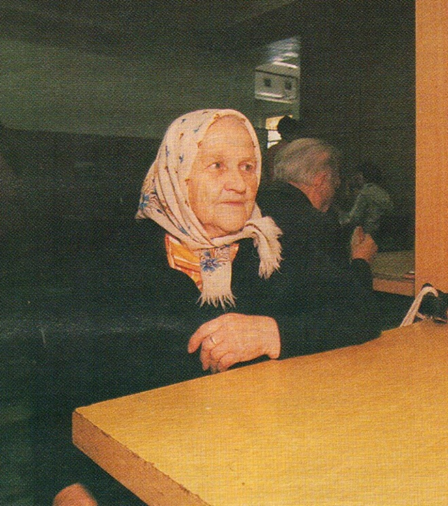
Lubov Vassilievna takes all day to sell a couple of loaves and some milk — she makes 17p.

Widow Lubov Vassilievna, 79, wears a colourful scarf and an orange-coloured cardigan over a print dress. Her wares are displayed on a cardboard box: one loaf and a one litre carton of milk. In her bag there are two more of each. It takes her all day to sell them and she makes less than 300 roubles (17p). She worked for 20 years in a shoe factory after bringing up her children. Her pension is 8,000 roubles (£4.45) a month. She told me, “I cannot remember when I last ate meat or sausages. I eat milk, potatoes, and bread but no butter, just oil to fry them in. I have no fruit or vegetables but I may be able to afford them later in the year when they get cheaper.”

Russian pensions are related to earnings. A wife who has a pension of her own gets no widow’s pension when her husband dies. Lubov Vassilievna is suffering from widowhood after a short, low-paid, working life when her children had grown up. Perhaps the children helped her now? She smiled: “I have a daughter, a granddaughter and two great grandchildren. I help them from my pension and what I make here. They need help because of the expense of everything and the new problem of unemployment. Soon I will be 80 and I am looking forward to that because my pension will be a bit more then. My main worry is that I have high blood pressure and medicines are very hard to get. It is a worry to know that you cannot get them when you need them.”

Like most of the women lining this busy thoroughfare, Lubov sells food on the street which she has bought in ordinary shops. Her customers are workers who are too busy or too lazy to queue for it themselves. Although there are no longer the chronic shortages and long queues which characterised daily life under communism, buying food is still a lengthy process. Choice is very limited in the small, local grocery shops which are all called, simply, Produkti (products).

One of these is nearby in a dirty, drab building. The windows are empty. Inside there are three counters: one stocks milk and cereals, another meat, mainly dried or preserved in some way, and a third vegetables. There are just six or seven different items at each counter with half a dozen people queuing for them. Patches of bare concrete show through the broken floor tiles; some new plastering is left unpainted. If the lighting had not been so poor, it would look even worse. Prices displayed on torn pieces of rough card show that butter is 1,180 roubles a kg (30p a pound), tea is 231 roubles for 100g (14p a quarter), and sugar is 355 roubles a kilo (9p a pound). The prices seem low when converted into sterling but they are not when they have to be found out of a pension consisting of just a few pounds a month.

At each counter there is a small queue. Occasionally, a veteran or disabled person goes to the head of the queue, which by convention they may, and they will be served at once. Others wait patiently. Once the few items have been chosen and the price calculated, either mentally or, in difficult cases, on an abacus, the customer is given a ticket. This process is repeated at each counter and the tickets must be taken to yet another queue at the central cash desk. In turn, the totals on the tickets are added — on another abacus — before the total is finally entered on a new Casio till! The customer takes the receipt to each counter in turn to collect the groceries. By enduring this long process then re-selling the goods on the street for a small profit, Lubov, like thousands of other women across Moscow, sells her time and patience to supplement her pension.

Fifty yards in front of the Izmaylovo International Hotel is the Ismaylovskaya Metro station. Forty women stand in two lines like an honour guard for the passengers emerging from its entrance. Maria, 63, holds aloft a large salami and a small plastic bag full of tomatoes. Occasionally a passer-by shows interest and asks the price. “My pension is 10,000 roubles (£5.55) a month because I had a low-paid job in a meat factory where I worked for 15 years. My husband died two years ago. I am here maybe two or three times a week, I make perhaps 1,000 or 1,500 roubles (55p-83p),” she said. Next to her is Alexandra, 70, selling milk. “My father was imprisoned by Stalin. He was taken when I was 14, so I had no education and could not get a good job, so I have a small pension. I buy milk in the shop for those who have not got the time to queue. I think this is a good use of my time and I make a few roubles.”

Not everyone buys the produce they sell. Outside a cheese shop in the south suburbs of Moscow, Ivan Mikhailovitch sits in front of a box on which are three portions of rocket, a kind of wild lettuce, replenished by the sackful. “My pension is 10,000 roubles (£5.55). I collect this in the woods and then sell it here two or three times a week. It is 50 roubles (3p) a portion.” 

Ivan Mikhailovitch supplements his pension by selling wild lettuce. He makes around 3p a portion.

 If the central market is the best in Moscow then Tishinksky market is the worst. On a piece of waste ground, in front of derelict buildings, using sheets of newspaper for stalls, Moscow’s poor sell to each other: rusty blunt drill bits and a handful of used brake shoes. Sergei, is selling his grandchildren’s old shoes, three out-of-date reel-to-reel tapes for which he claims to have a buyer, and four small steel hinges. At the entrance a woman sits in front of a small tray on which are various boxes of medication, dirty and old, but items which are hard to find in Moscow’s chemist shops.

Inside the market is Praskovia Ivanovna who lives alone in a one-room flat and sells empty 1.5 litre plastic bottles for 15 roubles each (less than 1p). Aged 80, her pension is 15,000 roubles (£8.33) a month. It is enough to live on, she says, but adds: “I haven’t eaten a tomato all year because they are too expensive. I sell my things here for almost nothing.”

A recent survey by the charity Care International found that pensioners living alone were the most vulnerable here. In the south west corner of Moscow, near the university, the International Protestant Church organises a modest response to this problem, providing meals for Moscow’s poorest and loneliest pensioners in what it calls a soup kitchen – a stolovaya or canteen. These stolovayas provide more than 10,000 meals a day to needy, people, mainly pensioners. The stolovaya I visited feeds 300 each lunchtime, staffed by volunteers and students, many from Nigeria who are in Moscow studying engineering. On offer today is a thin vegetable soup, plain pasta served with thick brown porridge, a hard boiled egg, two pieces of dark bread, and a glass of tea.

Anna Nikolayevna Volodina, 81, wears a white patterned scarf tightly drawn over her round face. Her black dress is old and worn and covered by a blue cardigan. Her shoes are thin. The Russian language has a wonderful term of love and respect for its older women — babushka or grandmother. If anyone personifies it, Anna does. She looks at her soup, pasta, and porridge and peels her egg. “The food here is very delicious,” she says. “I worked all my life in the Dulova china factory where I painted designs on cups and plates. After I retired I got 52 roubles pension and that was plenty. Now I get 8,000 roubles (£4.44) a month and it is not enough. I respect those who work in factories, but I do not respect these businessmen and speculators. They are really workers but they don’t want to work.”


Anna Nikolayevna Volodina personifies the Russian Babushka (grandmother). The stolovaya’s (soup kitchen) food is “very delicious”, she says.

 Her family, two sons and numerous grandchildren and great-grandchildren still live in Dulova, about 60 miles from Moscow. She remarried a Muscovite late in life and is now a widow but now that she is registered as a Moscow resident it is hard for her to move away.

“My sons don’t help me because they have many children themselves. One is a mechanic but wages are low and unemployment is now a constant fear. I live in a communal flat, I have one room and there are two other rooms with young men in them. We share a bathroom and kitchen. They don’t help me. No, if I’m not careful they would steal from me. I have bread and butter and tea for breakfast but I do not have enough to eat — the food here is very good. Hot meals of the sort I like. Really I am young, my life is young, I am hoping to live a very long time. I am always smiling and that is the important thing.” Her deeply lined white face breaks into a smile as the beauty and mischief break through the patient endurance of this wonderful babushka.

When flats were allocated by the state, the housing shortage was dealt with by putting childless people in communal flats. Unrelated, and often incompatible single people or couples, like Anna and her flatmates, would share three rooms, with common facilities, waiting for the time when they could get some privacy. It could take years but technically they were “housed”.


Viktor is homeless. He lost his documents so he receives no pension. “I sleep where I am”.

Now that the state no longer controls housing, there is real homelessness. Viktor is 57 and an epileptic. Married twice and an officially registered resident of Moscow, he is homeless. His dark face framed by a flowing brown beard, his dark-coloured, thick clothes and shoes tied with string. He smells of strong Russian tobacco. He eats at the stolovaya. “I was a carpenter. I have been married twice but now I sleep where I am. All my documents were stolen so I get no pension. Sometimes I collect old bottles and return them for a few roubles. Or I just beg. I get perhaps 100 or 200 roubles (5p-11p) a day. I eat here free but at other canteens I must pay 72 roubles (4p) for a plate of soup.”

John Melin is a Lutheran minister from Minneapolis, currently resident with the International Protestant Church in Moscow which runs the stolovaya. As people come and go they thank and praise him for his kindness. One woman stops to say, “I have worked for 63 years yet I have to come here for my food. God bless the church and God bless the Americans who help us.”

John explains, “We wanted to share with the people who were needy during the difficult transition from communism. This soup kitchen is our response to that need. We provide healthy traditional meals for 15 to 18 cents (10p-12p) each. Every dollar we are given goes straight to those in need. It is a food sharing ministry and I want to stress we provide service not just food, an opportunity to talk with people. Here they can sit, and be served, and talk. We do not proselytise. Our witness is in our service.”

A soup kitchen can never be more than a stop-gap measure to deal with the economic problems which create the terrible poverty prevalent in Moscow. Under the communist system, the welfare of older people was shared be-tween relatives and an elaborate system of organised care. Charities and voluntary organisations were banned by a state which had to seem to provide everything its people needed. But when the communist regime collapsed following the rapid political changes which followed the attempted coup in August 1991, the structures it supported went with it. The gap is slowly being filled by charitable efforts, according to Megan Bick, director of the Moscow office of the BEARR Trust (British Emergency Action in Russia and the Republics), an English charity devoted to helping the countries of the former Soviet Union.

Megan said, “The Trust keeps in touch with the local needs and channels help, from people in Britain, such as money or goods or technical aid about how the voluntary sector works.”

Prospekt Mira, or Peace Avenue, is a broad boulevard running due north out of Moscow past the exhibition of economic achievements which lies beneath a soaring titanium statue of a space rocket pointing skywards. Close to these monuments to Russia’s past a small group of people is trying to create the human side of its future.

The Alexeyevskiy district consists of 300 blocks of flats and is home to 80,000 people. It was built for those who worked on the Metro and among them are now an estimated 35,000 pensioners. Here, in a damp basement office that used to house communist party meetings, the Alexeyevskiy Fund, with some assistance from the BEARR Trust, is developing services for them. Its director is Tatiana Yurievna Pavlicheva, who used to work as a metallurgist in the defence industry until, in 1990, she became involved in distributing humanitarian aid. “It was a big problem about how to give aid to people who needed it and stop well off people from grabbing it. Doing this work made me realise what problems existed and I started trying to see what I could do. God wouldn’t forgive me if I didn’t do something.”

Her first step is to carry out a survey of the pensioners in the area and she expects to find about 1,000 who need help to cope alone. Like any western charity, the Alexeyevskiy Fund has to raise its own money. Tatiana appears to have found a uniquely Russian way of doing that, using the value of the newly privatised flats which these older people now occupy.

She explained: “An old woman lives alone and needs help. And there is a businessman who would like to have the flat when she dies. So the Fund sits in the middle. We contact the businessman, telling him that there is a flat of such a size in such a district and it is owned by a woman born in such a year but no other details. If he agrees, we get a lawyer to draw up documents so he pays money to our Fund and he will receive the flat in the end when she dies. The Fund then provides her with the services she needs for the rest of her life.”

Tatiana admits that with high inflation and investors wanting a quick return on their money, it is hard to persuade Russia’s new entrepreneurs to support the Fund now, in exchange for a possible return in several years’ time. But already one local businessman is paying some salaries in exchange for the promise of a flat when its octogenarian owners die. With salaries of 15,000 roubles (£8.50) a month and some flats worth $50,000 (£33,500) it could end up a very good deal. Already documents are being drawn up to allow the Fund to share in the profit to pay for some of its future projects.

It is a practical answer to the terrible problems which their older people face. They live in the biggest country on the planet, packed with natural resources. They have some of the best science and technology in the world and an enviable heritage of literature and art. They could have so much. But many have so little.

Translation: Lyudmila Alekseevna Cromova

Pictures: Grigory Dukor and Paul Lewis

Vs. 1.00 

20 April 2022


Saturday, 2 April 2022

HELP WITH RISING FUEL COSTS

The three measures announced by the Chancellor to reduce the effect of the huge April 2022 rise in electricity and gas prices


On 4 February 2022 the Chancellor, Rishi Sunak, announced three changes to, as he put it, 'take the sting' out of rising electricity and gas bills. They are 
  • £200 off every electricity bill in England, Scotland, and Wales from October 2022 to be repaid by a £40 surcharge on every electricity bill every year for the next five years starting in April 2023.
  • £150 off one council tax bill in April 2022 for homes in England in council tax bands A, B, C, and D.
  • An improved Warm Home Discount scheme for the winter of 2022/23  
The Chancellor claims that the package will cost £9.1 billion. But that includes £6 billion which will be lent to energy companies so they can take £200 off one electricity bill this autumn. That will be repaid over five years. So the net cost is a lot less.

Updated 2 April 2022


£200 off one electricity bill

In the autumn of 2022 there will be a £200 deduction from one domestic electricity bill. It will be applied by all energy providers in England, Scotland, and Wales. It cannot be refused - it will just appear on the bill. It is called the Energy Bill Discount Scheme. There will not be a deduction from gas bills.

If your bill is for less than £200 any credit balance will be carried forward to the next so you will get the full amount.

It will be up to individual energy suppliers how they amend monthly direct debits for those who pay that way.

The 4.5 million homes which have a prepayment meter will get the full deduction. If they have a smart meter it will normally be credited automatically. People who do not have a suitable smart meter or still have a meter where they have to pay to put credit on a token will normally get a voucher to use when they charge it up. This will be sent by email or post. Alternatively, it may be paid through what is called a Special Action Message (SAM) to retailers they use to top up their account so the credit can be applied then. If all else fails, they will get a cheque in the post. Everyone on a prepayment meter will get the full £200 deduction.

People who are on a fixed price contract will get the £200 discount. It is not clear how that will be paid.

It seems more likely now that the £200 discount will be paid before VAT is applied to the bill.

The Government will lend energy suppliers the money to give the discount. 

£40 a year repayment over five years
The £200 credit will be taken back through a £40 addition to every domestic electricity bill in 2023/24 and the next four years ending in 2027/28. 

The Chancellor told Parliament it will "automatically be repaid from people's bills in equal £40 instalments over the next five years". In a press conference he said the "discount will then be automatically repaid from people's bills over the next five years in equal instalments of £40 a year, starting next April."

Exactly when and how this repayment will be taken has not been finalised. In a Factsheet the Treasury said "it is expected to be reflected as an increase to standing charges on bills". And the Treasury has now told me "We expect for most energy customers, suppliers will reflect this as a standing charge on electricity bills. This means the £40 per year will be evenly distributed across the year. Households will not repay the £40 in a lump sum unless they choose to pay their bills annually."

If that happened it could add £40 a year or 10.96p a day (including VAT) to the standing charge on electricity bills. 

It is not clear yet how energy suppliers will amend monthly direct debits for those who pay that way. Nor is it clear how it will be deducted from those with a prepayment meter.

People on a fixed price contract will also have the extra £40 repayment added to their bills. 

Energy suppliers will use the amounts added on to bills to repay the Government loan given to make the initial £200 discount.

All these tricky points will be dealt with in a consultation in the spring on exactly how the Energy Bill Discount Scheme will work. It will be run by the Department for Business, Energy and Industrial Strategy.

Northern Ireland
The Northern Ireland Executive will be given around £150 million by Westminster to implement a similar £200 discount off one electricity bill. It will be expected to repay it through £40 additions to bills. But it can make its own decisions. There is no price cap in Northern Ireland and energy prices have been rising as the wholesale cost of gas has increased.

Anomalies
The £200 discount is not a personal loan, or a loan attached to a property or to a meter. It will simply be taken off every bill. Similarly, the £40 extra will simply be added to every bill once in each of the next five years. That will create some unfair situations.

Young people living with parents in the autumn of 2022 will not benefit from the discount. But when they move out and live independently they will pay the £40 a year extra on their electricity bills. On the other hand, people who are living independently and get a £200 discount but then move in together will only pay the extra £40 between them.

Each year the number of domestic electricity meters grows. In the year to September 2021, for example, official figures show that the number grew by 313,621. That is fairly typical. By October 2022 there will be around 27,000,000 domestic electricity meters. If that number grows by 300,000 a year there will be 28,500,000 by 2027 when the last £40 repayment is collected. The energy companies will have collected £180 million - about 3% - more than they paid out in 2022. The Treasury has now told me "If the number of domestic electricity meters grows the amount paid back by households will be slightly lower." 

Tenants who have their own rooms in multi-occupied houses do not pay for their electricity directly. The landlord pays and charges them. The landlord will get the £200 discount and have to meet the £40 repayments. It will be up to the landlord whether either is reflected in rents. 

Leaseholders or tenants in heat network or communal heating schemes will get the discount off their individual electricity bill. Where they do not have individual electricity accounts, the Treasury says it will be consulting "to ensure maximum eligibility".

On VAT the treasury says "Electricity bills are subject to VAT at 5%. This currently applies to levies and all other inputs to the bill. Government will work closely with industry and consumer groups on this issue through a public consultation in the Spring."

There are more details and a discussion of exactly what the discount and how the finance works by Joe Malinowski on the energyscanner website.

£150 council tax rebate in April 2022 

England
A £150 rebate will be given to some householders in April 2022. This rebate applies to England and only to people living in a home in council tax bands A to D. Your bill will tell you which band your home is in.  

People in Band E properties who have their Council Tax bill reduced to a Band D bill through the Disability Reduction Scheme will be eligible for the £150 rebate payment. 

Households where everyone is severely mentally impaired or all under the age of 18 and people in granny annexes who are exempt from council tax also be entitled to the discount.

The rebate will not be paid for second homes or empty properties. 

The status of the property is what it was on 1 April 2022.

This £150 will not have to be repaid.

Local councils will be responsible for paying the rebate. It will not be a deduction from the bill, it will be a payment from the council. People who pay their council tax by direct debit will get the money paid into their bank account automatically. They should be paid in April. Those who do not pay by direct debit will be asked for their bank details but that could delay the payments. They could speed up the process by setting up a direct debit now.  

The £150 discount will be given in full after any other deductions such as the 25% discount for a single person. It will be given where the council tax due is less than £150 even if it is zero. More than a million pensioners on pension credit for example have their council tax reduced to zero through council tax reduction. They are still liable for the tax but it is reduced to zero. They will get the full £150. The local council will contact them to get their bank details or they may be sent a cheque. How this works will be up to local authorities. People in that position should contact their council to find out more. The Treasury hopes it will all be sorted by May.

Students
Students in halls of residence will not get the rebate. 

The rules about houses or flats occupied by students are complex. 

A student who lives alone or two students living together with no one else in a self-contained flat or house is exempt from council tax but will get the rebate. They should contact the council to let it know their circumstances. See this guidance paragraph 11.

If three or more students live in a house share then the house is exempt from council tax. They may or may not get the rebate. If it counts as a House in Multiple Occupation they do not get the rebate. That normally means they have their own independent bed-sitting rooms. But if they just share the whole house then they should get the rebate. 

The guidance covering these circumstances is in paras. 11 and 12. Homes lived in entirely by students are in exemption class N. 

Students should contact the council but some councils have said they are still struggling with how to deal with these issues. 

Discretionary fund
Some groups in England will not get the £150 rebate
  • People in England who live in a property in band E, F, G, or H will not get the £150 rebate. That means many low-income pensioners living in home in Band E to H will not get it. 
  • Some houses occupied by students.
  • Tenants who pay the council tax as part of their rent will not get the rebate. It their landlord gets it they may not pass it on. 
To help these groups each council in England will be given a share of a £144 million fund which it can use to provide discretionary payments. On average they will get £467,500 which would enable them to give the full £150 to only 3000 or so people in their area. The mechanism for how this fund will work has not been worked out but it is likely that each council will have discretion to set different rules. They will be able to choose whether to pay the whole £150 or a lower amount.

The Department for Levelling Up, Housing and Communities has set out further guidance and also a more detailed Q&A. At times they may seem to contradict each other. 

Scotland, Wales, and Northern Ireland
The Westminster government will give the devolved authorities money "to enable them to provide similar support". Scotland will get around £290 million, Wales £175 million and Northern Ireland £100 million. Ministers in Scotland and Wales have questioned whether this money is extra or merely re-allocated from other budgets. In Northern Ireland, where there is no council tax, the rebate will probably be given to ratepayers.

The Scottish and Welsh governments have both announced their £150 rebate will go to two groups of households. 
  • Every householder in a band A, B, C, or D home, and
  • Every householder in a band E or higher home who gets council tax reduction on grounds of low income. 
Both governments have also announced that there will be a discretionary fund to help others who are in fuel hardship. Ask your local council about what extra help there may be.

Some councils in Scotland may pay the rebate as a deduction off the council tax or paid direct to the householder. 

In Northern Ireland no scheme to help with rates has been sorted out. With elections and the conflict over the First Minister this may not be resolved for some time.

Warm Home Discount Scheme

The Warm Home Discount scheme for England and Wales will be changed for the winter of 2022/23. The discount will be raised from £140 to £150 and expanded to include more households. But some households who received the money last winter will not get it in 2022/23. They include 290,000 households where someone receives DLA or PIP and 50,000 families with young children. It will be paid on top of the new measures announced above. 

Last winter the scheme applied in England, Wales, and Scotland but in Winter 2022/23 Scotland will have its own scheme. There will be a separate consultation on this. 

The new scheme
There will be two ways to be eligible for the new scheme.

Low income pensioners - Core Group 1
In the new scheme pensioners who get the guarantee element of pension credit will automatically qualify for the discount. They will be aged 66 or more and usually have an income of less than £182.15 a week (£278.70 for a couple). They do not have to claim. They will now be called Core Group 1.

Other households - Core Group 2
Anyone not in Core Group 1 may be eligible for the discount if 
  • they get a means-tested benefit (and in some cases have an income below a certain level) and
  • they live in a home that has high energy costs
The controversial change is that only those with 'higher energy costs' will qualify. That will exclude an estimated 290,000 people who get Disability Living Allowance or Personal Independence Payment who live in a building that does not have high energy costs. That is about 35% of the 810,000 who qualified last winter. 

The method of assessing high energy costs will also be controversial as it will be done automatically and related to the building not the people who live there. So a disabled person who needs warmth or to keep essential medical equipment going may be excluded. 

The Government says that 750,000 more people, many of them on low incomes who live in hard to heat buildings, will get help and that the cost will increase by £125m. People in both elegible groups will get the payment automaticaly and there will be a procedure for those excluded on hard-to-heat grounds to challenge the decision. Suppliers with fewer than 50,000 will not have to iffer the scheme - last winter it was fewer than 150,000. From 2023/24 that will will be reduced to fewer than 1000 customers.  

You can read the plans for Warm Home Discount from 2022 and the impact assessment which measures the gains and losses in a fairly impenetrable way.

Winter Fuel Payment

The Winter Fuel Payment is paid to people throughout the UK who have reached state pension age. The qualifying age for the winter 2022/23 will be those born on 25 September 1956 or earlier. The standard rate is £200 per household; if two or more people qualify in a household they get £100 each. If someone is aged 80 or more - which means born on 25 September 1942 or earlier - the payment is £300 for the household. It is normally paid automatically. But people who do not receive state pension or other state benefits should apply or they may not be included. Once paid it does not have to be claimed in future years. 

See Winter Fuel Payment at gov.uk.

Disclaimer
The information in this blogpost has been carefully checked with published sources, Treasury officials, and others. I am confident it is as full and accurate as it can be. It will be updated when fresh information comes to light. However, I take no responsibility if people rely on it and suffer any loss. Always check with official sources before taking action.

2 April 2022
version 1.50